

Fed’s About-Face Helped Kick Off Reflation Trade
The Federal Reserve’s rapid reversal on interest rates in the first few weeks of 2016 helped launch the reflation trade. The reflation trade is also known as the weak-dollar trade; both refer to leadership from assets that tend to perform well during periods of rising inflation expectations and/or a weakening U.S. dollar. Reflation is also used to categorize the early stages of economic improvement after a period of weakness or contraction. In June, the Fed shifted to maximum dovish mode, which may help propel the reflation trade to new heights.
Sustainable Leadership From Weak Dollar Assets?
While there is no question weak-dollar assets have responded to the Fed over the past few months, the jury is still out on the question of sustainability. The chart below shows the performance of materials (XLB) relative to the S&P 500 (SPY). Notice how similar periods of leadership ended in disappointment (red arrows below). The reflation trade has worked its way back to a similar area (orange arrow).
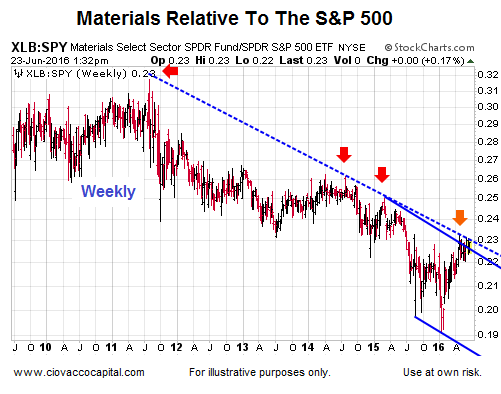
Could Brexit Push Materials Over The Top?
As noted on June 21, the markets have been leaning heavily toward the “stay in the EU” camp on this week’s Brexit referendum. It is possible the Fed’s June shift and a favorable Brexit vote are able to push XLB over the hump. Time, price, and ballots will tell.



Comments
Log in or sign up to join the conversation.